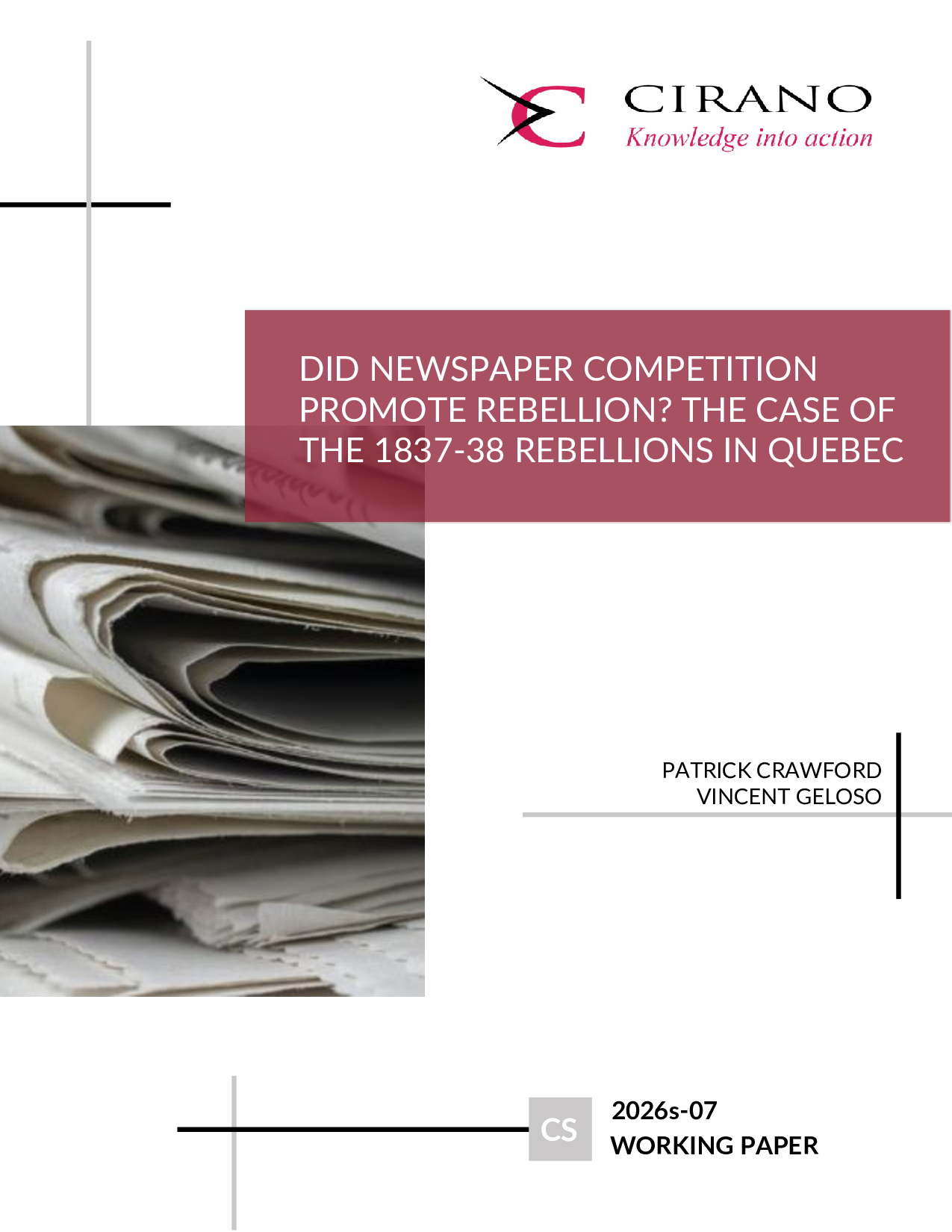
Did Newspaper Competition Promote Rebellion? The case of the 1837-38 Rebellions in Quebec
We investigate the relationship between media competitiveness and political mobilization during the Quebec Rebellion of 1837--38. We argue that the rebellion was shaped by newspaper coordination of political action. Drawing on a new spatial dataset of newspaper agents, we test whether local media competitiveness predicts the intensity of rebel mobilization, independent of the partisan alignment of the press. The effect is magnified in areas where seigneurial (i.e., feudal) tenure persisted, suggesting a complementarity between institutionally concentrated grievance and competitive press exposure. Adding newly created human capital controls---school enrollment and literacy---does not attenuate the competition effect. Globally, media competition transformed latent discontent into active participation in the conflict. These results offer insight into the economics of rebellions and uprisings.